Baby Oral Care: Gums, Tongue, Brushing and First Dental Visits (0 to 3 Years)
Baby oral care is the daily routine of cleaning your baby’s gums, tongue and teeth from birth, then adding brushing and dental check-ups as the first teeth come through. It starts long before there is anything to brush, and the habits built in the first year are the ones that carry into toddlerhood.
Why Baby Oral Care Starts Before the First Tooth
Baby teeth hold space in the jaw for the adult teeth forming underneath, so losing one early to decay can affect how the permanent teeth come through. Decay can begin as soon as a tooth appears. The US Centers for Disease Control and Prevention (CDC) calls cavities the most common chronic disease of childhood in the United States, where more than half of 6 to 8 year olds have already had one in a baby tooth. That figure is American rather than Malaysian, but the point holds: this is common, and it starts early. For what causes decay and how dentists treat it, see our guide to tooth decay in kids.
How Do You Clean a Baby’s Gums and Tongue (0 to 6 Months)?
Start before the first tooth. Malaysia’s Ministry of Health (MOH) advises wiping the gums and tongue with a clean gauze or cloth wrapped around your forefinger to remove milk remnants. The CDC adds a schedule: twice a day, once in the morning after the first feed and once right before bed, which clears the bacteria and sugars that cause cavities.
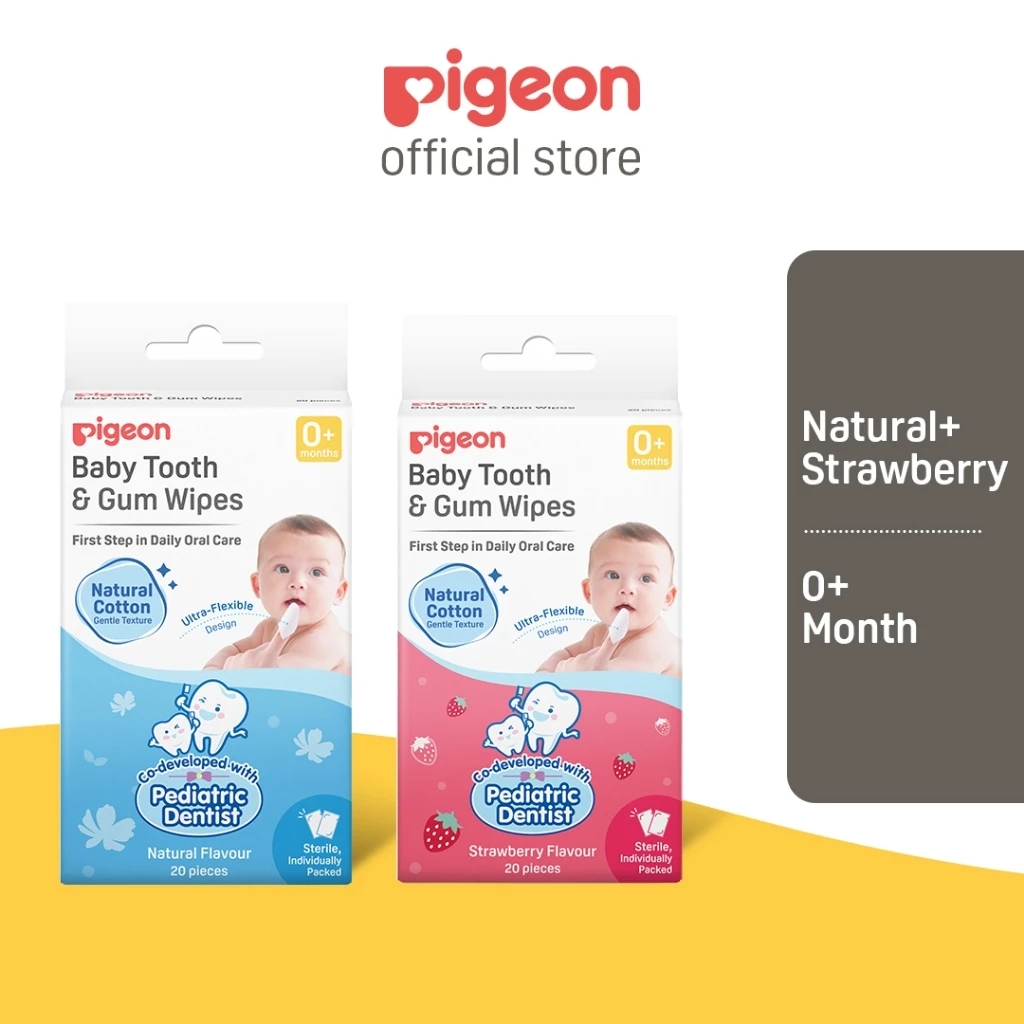
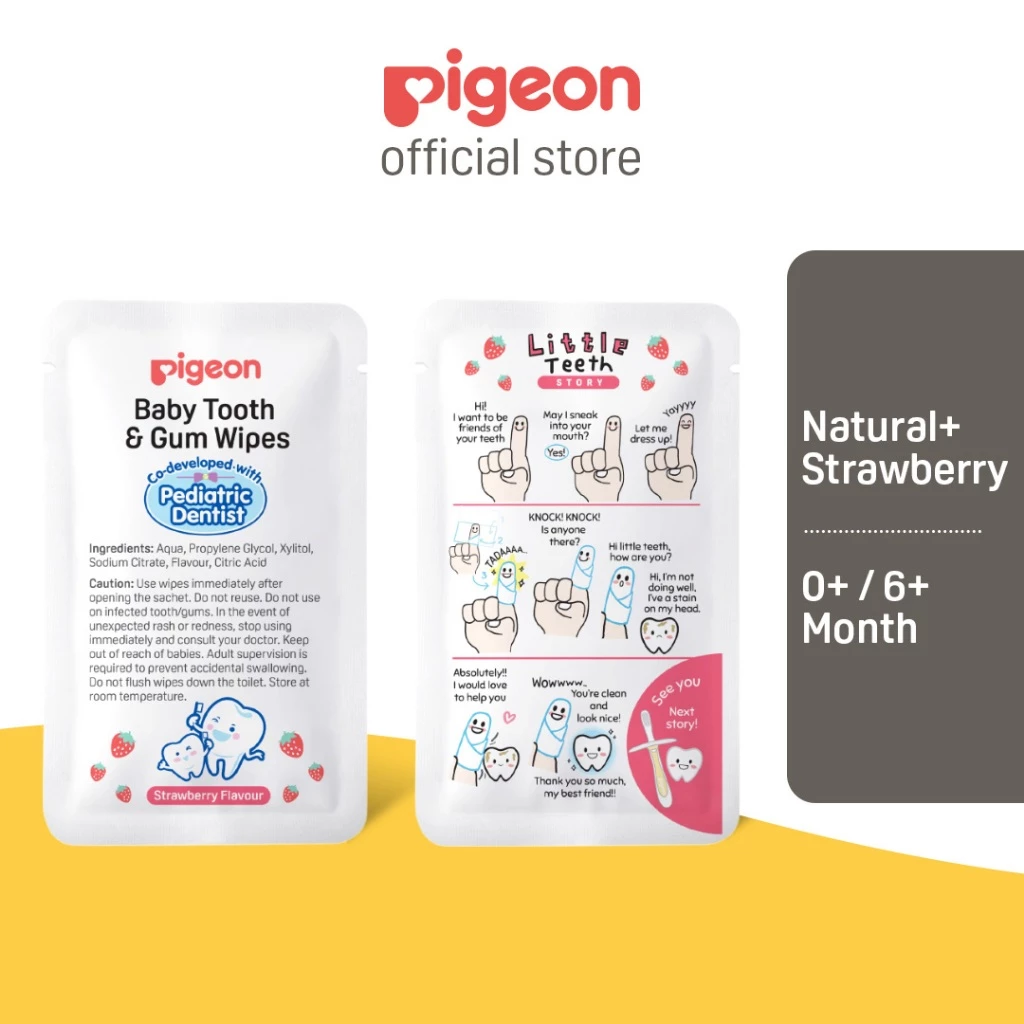
A clean damp cloth does the job, and Baby Tooth and Gum Wipes are made for this from birth. Each one is sterile, individually packed natural cotton with food-grade ingredients and no alcohol, colouring or preservatives. Wrap it around your finger, wipe the gums and tongue, and there is no need to rinse after.
Milk also settles on the tongue, so wipe it gently with the same cloth or wipe after feeding. Malaysian parents often search for this as cara cuci lidah bayi. MOH names the tongue alongside the gums, so it belongs in the routine rather than being an extra: a soft wipe, no scraping, and stop if your baby turns away. Pigeon’s Silicone Finger Toothbrush, made for babies from 3 months, has a tongue cleaner on the reverse for exactly this.
What Changes When the First Tooth Arrives (Around 6 Months)?
When Do Babies Start Teething?
Most babies start teething at around 6 months, though some start earlier and others not until after 12 months. Bottom front teeth usually come first, top front teeth at about 8 months, first molars around 12 months, and the full set of 20 milk teeth by roughly 2 to 3 years.
Expect a sore, red gum where the tooth is coming through, more dribbling than usual, chewing on everything, and some broken sleep. A slightly raised temperature is common, but the NHS says it should stay under 38°C, and teething does not cause diarrhoea. Anything past that is worth a doctor’s look rather than being put down to teeth.
How Do You Brush a Baby’s First Tooth?
The American Academy of Pediatrics says to begin brushing as soon as that first tooth comes in, twice a day, after breakfast and before bedtime. The NHS gives the same instruction, to start as soon as the first milk tooth breaks through, brushing for about two minutes each time.
Wiping does not stop once brushing starts. The gum wipes still have a place for the gums and the tongue, and for days out when a brush is not practical.
 |
 |
Which Toothbrush Suits Each Stage?
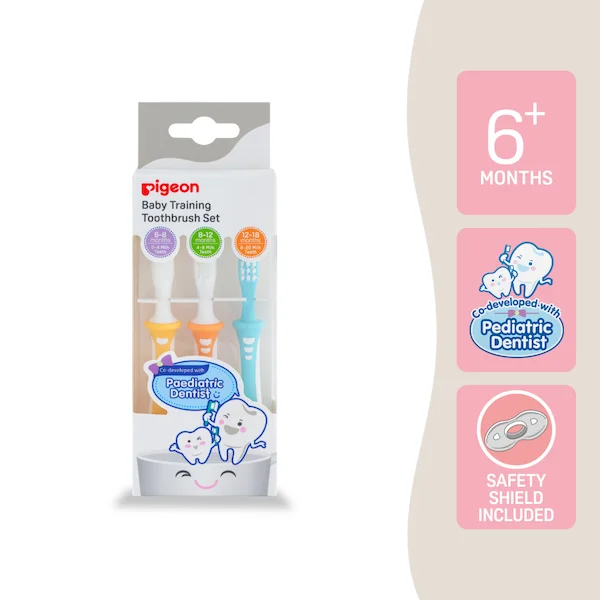
A baby’s first brushes are training tools as much as cleaning tools. Pigeon’s Training Toothbrush range, co-developed with paediatric dentist Dr Rashid Tahir, steps through four stages:
| Stage | Age | What it’s for |
| Lesson 1 | 6 to 8 months, 0 to 4 milk teeth | Introduces the feel of a brush |
| Lesson 2 | 8 to 12 months | Introduces proper brushing movements |
| Lesson 3 | 12 to 18 months, 8 to 20 milk teeth | The first real toothbrush |
| Lesson 4 | From 18 months, 12 to 20 milk teeth | For when your child brushes with less help |
Whichever berus gigi bayi you choose, you are still the one doing the cleaning at this age. Your child’s own brushing is practice that sits alongside yours, not a replacement for it.
How Much Toothpaste Should You Use at Each Age?
The right oral care routine evolves as your child grows and develops the physical ability to spit out excess toothpaste. Here is how to pair the correct tools and toothpaste at each stage:
- 0 to 12 Months: As teeth appear, introduce Pigeon Training Toothbrush Lesson 1 (6-8 months) and Lesson 2 (8-12 months) using Baby Toothpaste to establish a routine early.
- 1 to 3 Years: Transition to Pigeon Children’s Toothpaste paired with Training Toothbrush Lesson 3 or Lesson 4. Apply a tiny smear the size of a grain of rice of Children’s Toothpaste with at least 1,000ppm fluoride. This small dosage delivers crucial cavity prevention while remaining safe as toddlers learn not to swallow.
- 3 to 6 years: a pea-sized amount. Continue using 1,000ppm fluoride toothpaste, but increase the dosage to a pea-sized amount. Encourage your child to spit out excess toothpaste rather than rinsing with water, so the protective fluoride layer stays active on their enamel.
One point to settle with your own dentist. The AAP and the NHS both support fluoride toothpaste from the first tooth, while the CDC advises parents of children under 2 to consult a doctor or dentist first. Follow your dentist’s advice rather than a single rule. For which ubat gigi bayi suits which age, see our guide to baby toothpaste for different ages.
Everyday Habits That Protect Baby Teeth
Most of this is aimed at preventing early childhood caries, tooth decay in children under 6. Malaysia’s Ministry of Health puts the common causes as frequent sugary food and drinks, brushing that is skipped or leaves plaque behind, bottle feeding with milk containing sucrose, sugar-based medicines, and bacteria passed from mother to child through saliva.
Ask your dentist or doctor about fluoride varnish as soon as the first tooth appears. The CDC says it can prevent one third of cavities in baby teeth, and the application itself takes only minutes.
Beyond that, consistency does most of the work. Keep brushing at the same two points in the day, after breakfast and before bed, so it becomes routine rather than a negotiation. Expect resistance somewhere in the second year, and keep the session short and calm rather than forcing a full two minutes on a bad night.
When Should Your Baby First See a Dentist?
Earlier than most families expect. The AAP says to see a dentist by the first birthday or within six months of the first tooth, and the NHS gives the same timing, when the first milk teeth appear or before 12 months. Malaysia’s Ministry of Health says the same, with the first visit at 6 months or after the first tooth erupts, and no later than one year.
In Malaysia, the Ministry of Health also runs an Early Childhood Oral Healthcare Programme, an extension of its antenatal programme aimed at postnatal mothers and at parents and carers of children aged 4 and below seen under MOH Child Health Services. Its stated objective is to promote and maintain toddlers’ oral health, so a government clinic you already attend for child health check-ups is a place to ask. It guides parents rather than treating children, though, so the dental appointment itself is still yours to book. From preschool onwards the School Health Programme, run jointly by MOH and the Ministry of Education, adds dental check-ups, oral health education and preventive treatment.
An Oral Care Routine That Grows With Your Child
Pigeon was founded in Japan in 1957 and has spent decades researching how babies feed, suck and develop. That research is why its oral care range is built as a sequence rather than a shelf of unrelated products. Co-developed with paediatric dentists, it steps from tooth and gum wipes, to the Silicone Finger Toothbrush from 3 months, to the four Training Toothbrush lessons, to a children’s toothpaste carrying 1,000ppm fluoride and xylitol from 1 year. The formulas use food-grade ingredients and contain no parabens or SLS.
Ready to build the routine? Explore Pigeon’s baby oral care range.
Frequently Asked Questions
When should I start cleaning my baby’s gums?
From birth, before any teeth appear. The CDC recommends wiping the gums twice a day with a soft, clean cloth, once in the morning after the first feed and once right before bed. This clears the bacteria and sugars that cause decay.
When should I start brushing my baby’s teeth?
As soon as the first tooth comes through, usually around 6 months. Both the AAP and the NHS give the same instruction. Before that first tooth, wipe the gums with a soft, clean cloth twice a day.
How often should I brush my baby’s teeth?
Twice a day, after breakfast and before bed, for about two minutes each time, which is what both the AAP and the NHS advise. Keep the bedtime session consistent, and brush for your child rather than handing over the brush at this age.
Do babies need fluoride toothpaste before age 1?
Guidance differs, so ask your dentist. The AAP and the NHS both support fluoride toothpaste from the first tooth, using a rice-grain smear of at least 1,000ppm. The CDC advises parents of children under 2 to check with a doctor or dentist first.
How do I clean my baby’s tongue?
Wipe it gently after feeding with a soft, clean damp cloth, or with a finger toothbrush that has a tongue cleaner, using the same light pressure you would use on the gums. No scraping, and stop if your baby resists. Malaysia’s Ministry of Health includes the tongue in its advice on cleaning a baby’s mouth, so it belongs in the daily routine.
When should my baby first see a dentist?
By the first birthday, or within six months of the first tooth coming through, whichever comes first. Both the AAP and the NHS give this timing. In Malaysia, the MOH Early Childhood Oral Healthcare Programme supports parents of children aged 4 and below through Child Health Services.
Sources
- American Academy of Pediatrics (HealthyChildren.org) – Toothbrushing Tips for Young Children
- NHS – Baby teething symptoms
- NHS – Taking care of children’s teeth
- Centers for Disease Control and Prevention – Oral Health Tips for Children
- Ministry of Health Malaysia Oral Health Programme – Toddler Programme: Early Childhood Oral Healthcare Programme
- Malaysia.gov.my – School Health Programme for Preschoolers
- Portal MyHEALTH, Ministry of Health Malaysia – Early Childhood Caries
- Portal MyHEALTH, Ministry of Health Malaysia – Mother’s Role in Dental Care for the Young
- Portal MyHEALTH, Ministry of Health Malaysia – How do I Care For My Toddler’s Teeth?